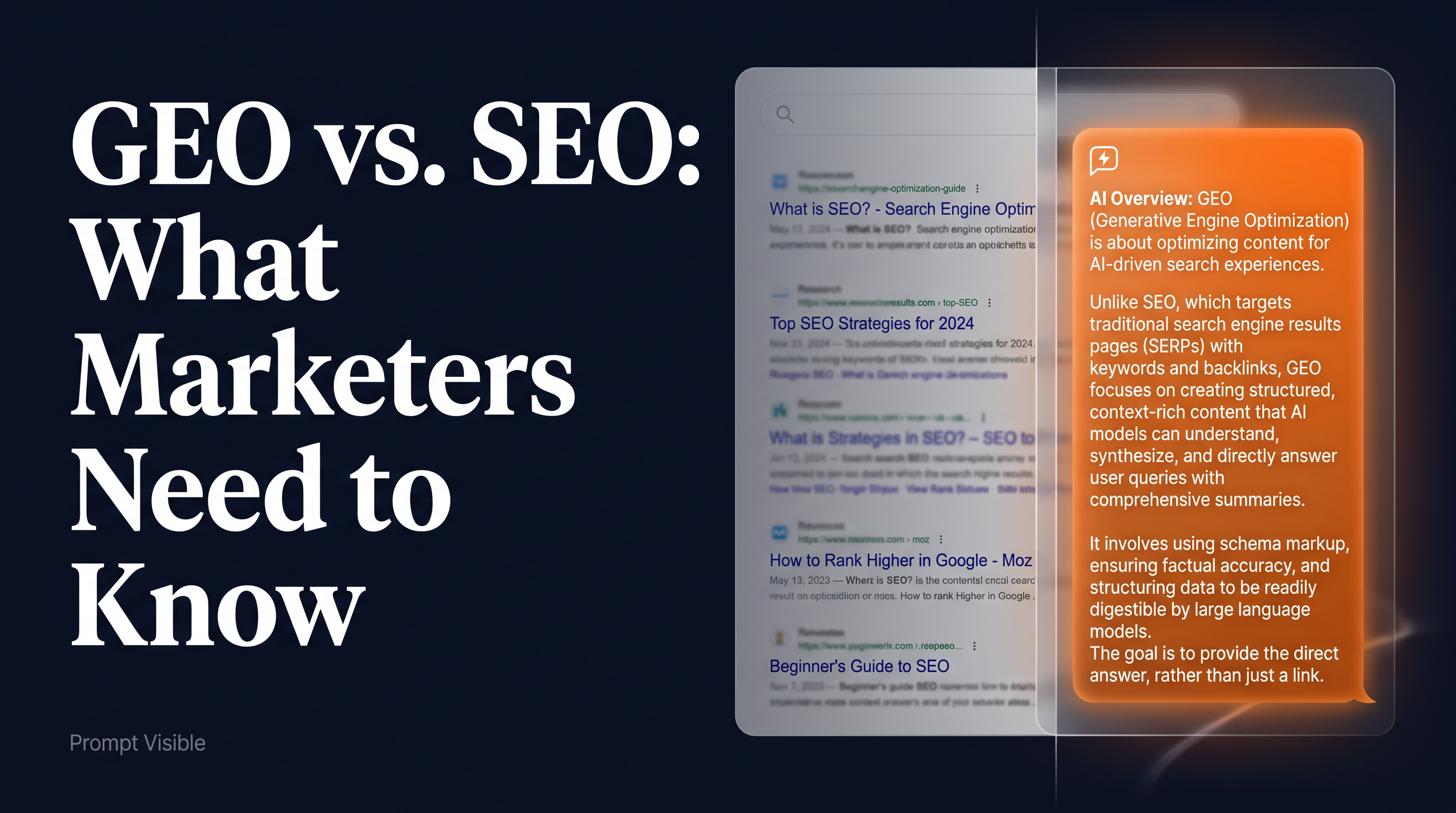
For two decades, Search Engine Optimization (SEO) has been the undisputed king of digital acquisition. Marketers optimized for keywords, built backlinks, and fought for the top spot on Google's Search Engine Results Page (SERP) to capture clicks.
But the landscape has fractured. Users are increasingly bypassing traditional search engines in favor of conversational AI assistants like ChatGPT, Perplexity, and Claude. They don't want a list of ten blue links; they want a synthesized, direct answer.
This shift has given rise to a new discipline: Generative Engine Optimization (GEO). While GEO shares some DNA with traditional SEO, the tactics required to succeed are fundamentally different. Here is what marketers need to know to adapt their strategies in 2026.
The Goal: Clicks vs. Citations
The most profound difference between SEO and GEO lies in the ultimate objective.
Traditional SEO optimizes for discovery and clicks. The goal is to rank high enough on the SERP that a user clicks through to your website, where you can then attempt to convert them. The search engine is merely a conduit.
GEO optimizes for extraction and citations. The goal is to have the AI model understand your brand's value so thoroughly that it includes your business directly in its synthesized answer. In many cases, the user may never visit your website. The conversion — or at least the initial brand consideration — happens entirely within the AI interface.
Content Strategy: Narrative vs. Information Density
Because the goals are different, the content required to achieve them must also change.
Traditional SEO often favored long-form content designed to keep users on the page (increasing dwell time) while naturally weaving in semantic keywords. This led to the infamous "recipe blog" format, where a user had to scroll through a lengthy personal narrative before reaching the actual ingredients.
AI models despise this format. They are designed to extract facts quickly and efficiently. GEO requires "information density." Content must be structured for immediate extraction by a machine. This means:
- Prioritizing structure: Heavy use of clear H2/H3 headings, bulleted lists, and HTML tables.
- Direct answers: Answering the user's implied question in the very first sentence of a section, rather than burying it at the end [1].
- Factual density: Replacing marketing adjectives ("industry-leading," "innovative") with verifiable data points ("processes 10k transactions per second," "founded in 2018").
Authority: Backlinks vs. Consensus
In traditional SEO, backlinks act as votes of confidence. If many high-authority websites link to your page, Google assumes your content is valuable and ranks it higher.
While AI models do factor in traditional search rankings (which are influenced by backlinks), they rely much more heavily on "consensus" when formulating an answer. If an AI is asked to recommend the best project management software, it doesn't just look at who has the most backlinks. It cross-references the brand's claims against third-party reviews, discussions on Reddit and Quora, and mentions in digital PR [2].
In GEO, a positive, detailed review on G2 or a highly upvoted recommendation in a relevant Reddit thread can be significantly more valuable than a traditional backlink from a high-DR blog.
Technical Optimization: sitemap.xml vs. llms.txt
Technical SEO focuses on ensuring Googlebot can crawl and index a site efficiently. This involves managing robots.txt, optimizing site speed, and maintaining a clean sitemap.xml.
Technical GEO requires these same foundations, but adds new layers specifically for AI crawlers:
- Unblocking AI bots: Ensuring that crawlers like
GPTBotandPerplexityBotare not inadvertently blocked by server firewalls orrobots.txtrules. - Implementing llms.txt: Adopting the new
llms.txtstandard to provide AI models with a clean, machine-readable summary of your site's architecture and core documentation. - Robust Schema Markup: Using structured data (like Organization, Product, and FAQPage schema) to explicitly define entities for the AI, removing any ambiguity about what your business does.
The Hybrid Approach
You do not need to abandon traditional SEO. Google still processes billions of searches a day. However, a modern digital strategy must incorporate GEO principles to capture the growing segment of users who prefer AI assistants.
By structuring your data clearly, focusing on information density, and building third-party consensus, you can optimize for both the algorithm of today and the AI of tomorrow.
Is your brand visible to AI?
Run a comprehensive AI visibility audit with Prompt Visible to find out. Get your baseline score and a prioritized list of GEO fixes in minutes.
References
[1] Search Engine Land. "Generative Engine Optimization (GEO): The future of SEO?" searchengineland.com
[2] Seer Interactive. "STUDY: What Drives Brand Mentions in AI Answers?" seerinteractive.com