
Perplexity is the most winnable AI engine for most businesses, because unlike ChatGPT it cites sources in every single answer, and it re-reads the live web every time someone asks. You are never locked out by old training data. If your content deserves the citation today, Perplexity can cite you today.
TL;DR: Perplexity runs a live web search for every question, reads a small set of pages, and synthesizes an answer with numbered citations. To become one of those citations you need three things: PerplexityBot must be able to reach your pages, your content must answer questions directly with dense, sourced facts near the top of the page, and independent sources (reviews, communities, press) must corroborate that you are who you say you are.
Perplexity is an answer engine, not a search engine
Perplexity does not maintain a ranked index for you to climb. When a user asks a question, it searches the live web, retrieves a handful of pages, and composes an answer with numbered citations pointing at the exact sources it used. This is Retrieval-Augmented Generation, and it changes the job completely: you are not competing for position #1 on a list, you are competing to be one of roughly three to six sources a machine chooses to trust for one specific question.
Two properties of that design matter enormously for your strategy. First, freshness works in your favor: because Perplexity retrieves live, content you publish this week can be cited this week. No waiting for a model retrain. Second, the competition is different from ChatGPT's: research from Profound analyzing over 680 million AI citations found that only 11% of domains are cited by both ChatGPT and Perplexity. Winning one engine does not automatically win the other, and Perplexity is the one where deliberate effort pays back fastest. The click-behavior shift behind all of this is well documented: Pew Research found that users click a traditional result in only 8% of visits when an AI summary appears.
Step 1: Let PerplexityBot in (two minutes, most commonly failed)
The most common reason businesses are invisible on Perplexity is that PerplexityBot never sees their pages. Check two things right now:
- robots.txt. Open yoursite.com/robots.txt and confirm there is no Disallow rule under User-agent: PerplexityBot. Several popular CMS platforms and security plugins block AI crawlers by default.
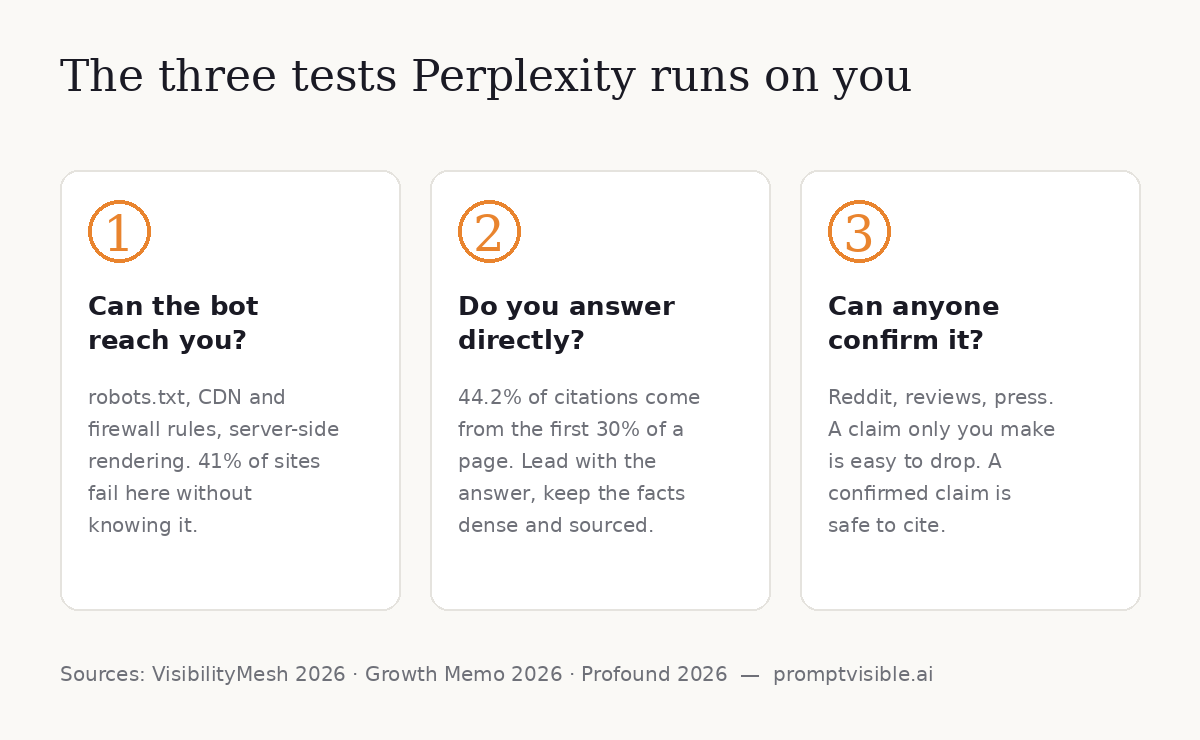
- Your CDN or firewall. Cloudflare and similar services offer one-click "block AI bots" settings that return challenge pages to PerplexityBot while your site looks perfectly normal to you. This is invisible failure: a study of 216 storefronts by VisibilityMesh found 41% failed basic crawler accessibility.
One more trap: Perplexity's crawler does not reliably execute JavaScript. If your pages only assemble in the browser, the bot may see a blank shell. Server-side rendering for your key pages is not optional in 2026.
Related reading: Are You Blocking AI Crawlers? How to Check robots.txt
Step 2: Write answers, not articles
Perplexity extracts passages, not pages. Kevin Indig's Growth Memo analysis of 18,012 verified ChatGPT citations found that 44.2% of all LLM citations reference content from the first 30% of a page, and content buried deep in a long post is roughly 2.5x less likely to be cited. The structural rules that follow from this:
- Open every section with the answer. First sentence is a complete, self-contained claim. Nuance and context come after, never before.
- Be information-dense. Perplexity favors pages with specific numbers, dates, names, and steps over pages with mood and adjectives. "Pricing starts at $149 and the report is emailed as soon as the audit completes" is citable. "Affordable and fast" is not.
- Cite your own sources. Pages that reference named data sources get weighted as more trustworthy during retrieval. Research from Princeton and Georgia Tech presented at the KDD Conference measured up to 40% citation improvement from adding quotation-worthy statistics and sources.
- Add a real FAQ. Question-formatted headings map directly onto how Perplexity users phrase queries. Answer each in two to four sentences, answer-first.
Step 3: Build the corroboration Perplexity checks
Perplexity cross-references. A claim that exists only on your own website is easy to drop from an answer; a claim confirmed by independent sources is safe to cite. The external signals that matter most, ranked by observed citation volume: community discussion (Reddit alone accounts for roughly 40% of citations across major AI engines per Profound and Semrush 2026 data), review platforms (businesses with active G2 or Trustpilot profiles show roughly 3x more AI citations per SE Ranking), and trade press (27% of all AI citations, rising to 49% for time-sensitive queries). The zero-click backdrop makes these signals compound: SparkToro's 2026 analysis found 68% of U.S. Google searches now end without a click.
You do not need all of them at once. One honest Reddit thread where your category is discussed, a claimed review profile with a handful of real reviews, and consistent name-category-location facts across your site and profiles put you ahead of most of your competitors.
How to check where you stand today
Open Perplexity and ask the question a real buyer would ask. Plain language, no brand names: "best [your category] in [your city]" or "which [your product type] should a small business use." Three possible outcomes:
- You're cited with accurate details. You're ahead. Protect it by keeping facts fresh.
- Competitors are named, you're not. You have a corroboration gap, not a content-quality problem. Start with Step 3.
- Generic advice, no names. Your category is unclaimed. First mover takes it, and on Perplexity that can happen in weeks, not months.
GEO practitioners consistently report results appearing within 60 to 90 days of steady work, and Perplexity is typically the first engine to move because it retrieves live. It is the fastest feedback loop in AI search, which is exactly why it is the best place to start.
Frequently asked questions
Does ranking on Google help me rank on Perplexity? Partially. Perplexity's retrieval uses web search signals, so pages that rank tend to get retrieved more often. But retrieval is only the first step. Being cited depends on direct-answer structure and corroboration, and plenty of #1-ranked pages get retrieved and then dropped from the answer.
How long does it take to show up in Perplexity answers? Faster than any other AI engine. Because Perplexity reads the live web, technical fixes and new content can influence answers within days to weeks. Corroboration signals like reviews, community presence, and press take 60 to 90 days to compound.
Do I need llms.txt for Perplexity? It is a low-effort positive signal: a plain markdown file at your site root summarizing who you are and which pages matter. It will not rescue a blocked crawler or thin content, but it helps models frame your business correctly. Full guide here.
How do I measure my Perplexity visibility over time? Run the same 10 to 30 buyer questions weekly and log whether you are cited. A single check is noise; the monthly trend is the signal. Our audit automates this across Perplexity, ChatGPT, Claude and Gemini. Run a free snapshot to get your baseline in about two minutes.
Prompt Visible runs real prompts against Perplexity, ChatGPT, Claude and Gemini and shows you exactly which answers name your business, and which name your competitors. Get your free AI visibility snapshot.