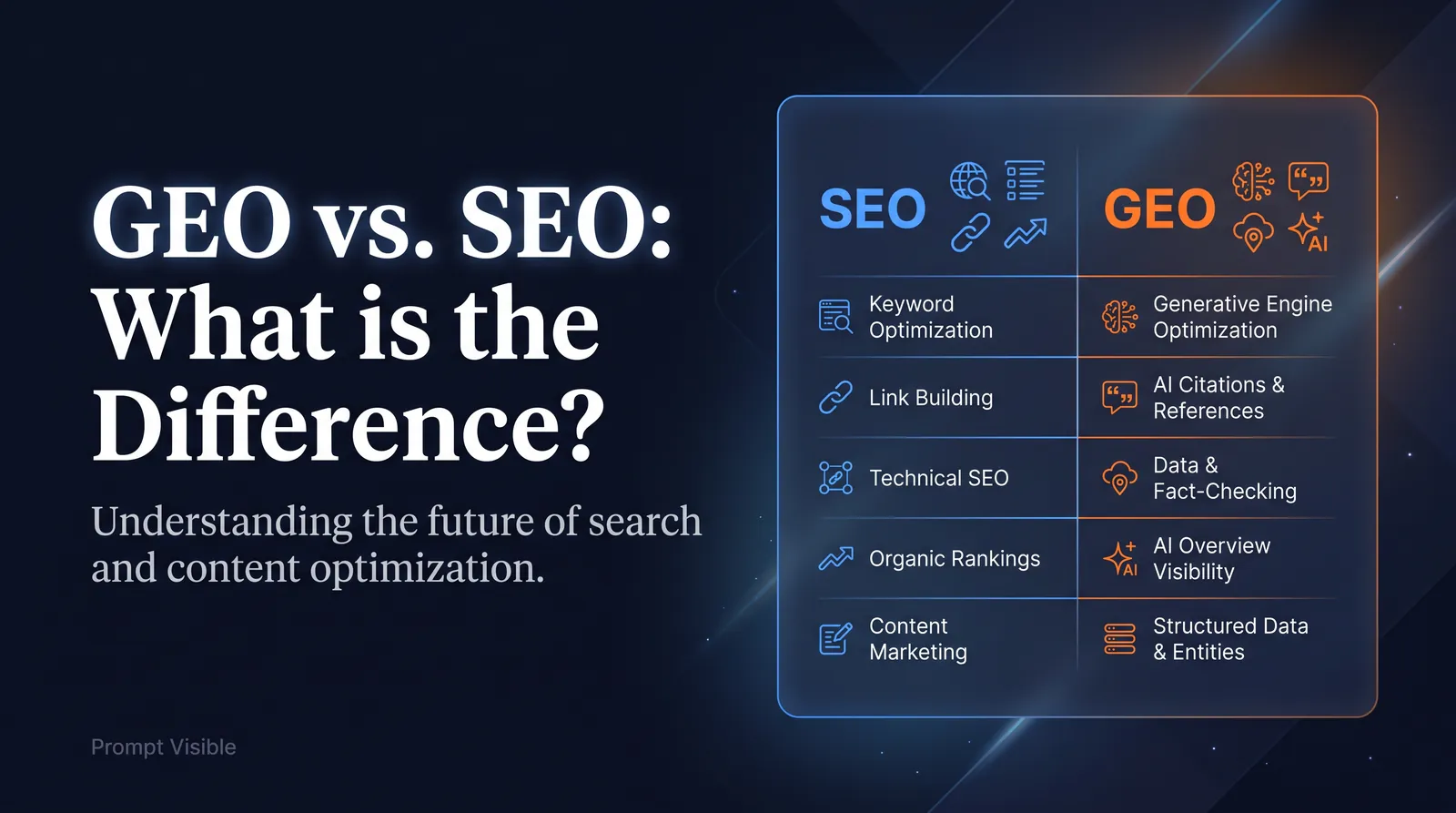
For two decades, Search Engine Optimization (SEO) was the undisputed king of digital marketing. But in 2026, a new acronym is dominating the conversation: Generative Engine Optimization (GEO). Many marketers assume GEO is just a new buzzword for SEO. It is not. While they share some foundational principles, they are different disciplines with different goals, different metrics, and different rules for success.
If you apply a traditional SEO playbook to an AI assistant, you will miss part of the picture. Here is how GEO differs from SEO, what carries over, and why you need both.
The Goal: Clicks vs. Citations
The most profound difference between the two is the ultimate objective.
SEO is about winning the click. You optimize your page to appear high on a Search Engine Results Page (SERP). The search engine provides a list of links, and you want the user to click yours.
GEO is about winning the citation. You optimize your presence across the web so that an AI assistant (like ChatGPT or Perplexity) uses your business as source material when it writes an answer. The assistant gives the answer directly. You may never get a click, but you win the recommendation.
The Algorithm: Keywords vs. Consensus
SEO relies on keywords and backlinks. Google's algorithm matches the user's query to the page with the highest relevance (keywords) and authority (backlinks).
GEO relies on entities and consensus. AI assistants care less about keyword density and more about facts they can confirm. When asked a question, an assistant looks for clear, extractable facts and agreement from other sources. If your website claims you are the best, but reviews and listings say otherwise, the assistant is unlikely to recommend you.
The Content: Narrative vs. Extraction
SEO content is often narrative. Marketers write 2,000-word posts designed to keep readers on the page and weave in long-tail keywords. The answer is often buried deep in the text.
GEO content must be extractable. Kevin Indig's Growth Memo analysis of 18,012 ChatGPT citations found that 44.2% of them came from the first 30% of a page [1]. Put a plain, factual summary first. Use clear headings, short lists and structured data so the assistant can find the answer quickly.
The Technical Foundation: Sitemaps vs. llms.txt
SEO relies on sitemap.xml. You provide a map of your URLs so search engines can find and index your pages.
GEO sometimes adds llms.txt. It is a markdown file at your domain root that summarizes your business, your prices and your most important pages. It is optional: Google says "You don't need to create new machine readable files, AI text files, or markup to appear in these features" [2]. Crawler access matters far more: if your robots.txt or firewall blocks AI crawlers, they can't read your site at all.
What Carries Over from SEO
- Technical foundations. Fast, crawlable, server-rendered pages work for search engines and AI assistants alike.
- One clear topic per page. One service, one URL, one plain answer.
- Trust signals. Real company details, named authors and links to primary sources.
- Depth. Thin pages don't rank and don't get cited. Specific, useful pages can do both.
You Need Both
SEO is not dead. Traditional search still drives a large share of traffic. But as "zero-click" answers take a bigger share of searches, SEO alone is no longer enough. If GEO is new to you, start with the plain-English guide to Generative Engine Optimisation, then read why ranking number 1 on Google no longer protects your traffic.
Want to know whether the assistants name your business? Run the free AI visibility check. We ask ChatGPT, Claude, Perplexity and Gemini one question your customers ask and show you who they named. It doesn't include a fix list.
References
[1] Kevin Indig. Growth Memo. growth-memo.com
[2] Google Search Central. "AI features and your website." developers.google.com