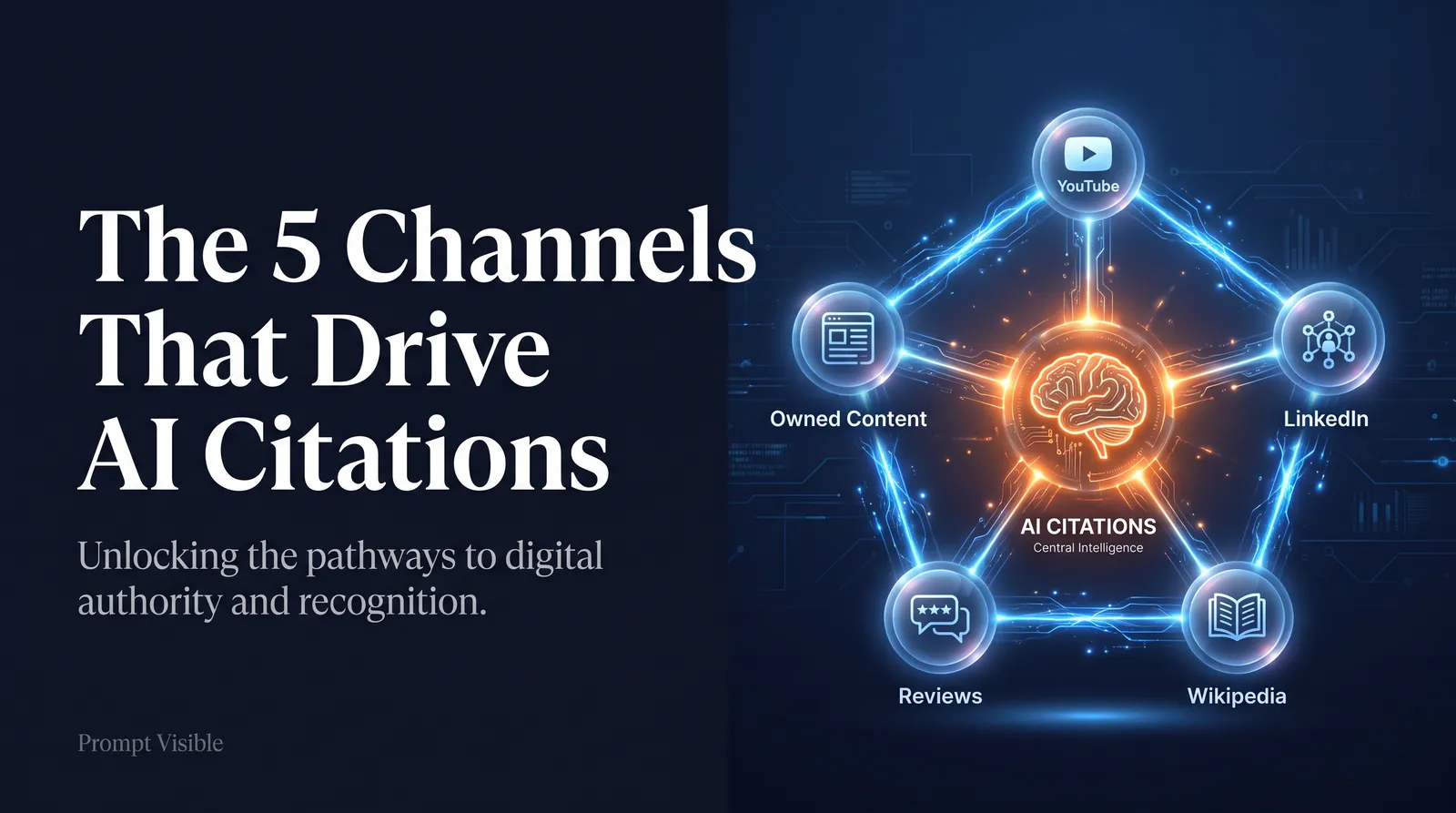
If you want to appear in ChatGPT or Perplexity answers, fixing your website is only half the battle. Large Language Models (LLMs) are designed to synthesize consensus. If your website is the only place on the internet claiming that your product is the best, AI models will ignore you. They look for third-party validation to confirm that your claims are true.
To build true Generative Engine Optimization (GEO) authority, you must establish a presence across the channels that AI engines trust most. Here are 5 channels that can support AI brand citations.
The 5 Channels AI Engines Pull From
1. YouTube (The Explainer Engine)
YouTube transcripts are heavily mined by AI models. If your brand is mentioned in in-depth video tutorials, reviews, or industry breakdowns, the AI extracts that data. Ensure your own videos have clear, keyword-rich transcripts and timestamps — the AI reads the words, not the footage.
2. LinkedIn (The B2B Authority Engine)
For professional and B2B questions, LinkedIn is a common source. AI models trust the platform's professional context. Publishing authoritative thought leadership and pillar posts on LinkedIn feeds the AI the exact type of expert data it craves.
3. Wikipedia (The Trust Anchor)
Wikipedia is one of the external sources AI engines lean on for basic facts about organizations. While getting a Wikipedia page is difficult, ensuring your brand is mentioned as a reference in broader industry articles is a powerful GEO tactic.
4. Review Platforms (The Reputation Signal)
Reviews count. When Insites ran 10,000 US local businesses through ChatGPT and Perplexity, the businesses both assistants recommended averaged 133.4 Google reviews, against 10.7 for businesses neither recommended (Insites, July 2026; Insites sells AI visibility audits). AI models use review platforms to extract pros, cons, and overall sentiment to formulate balanced answers. The text of the reviews matters as much as the star rating — AI mines the language to match specific user prompts.
5. Owned Content (Your Website)
Your own website remains the foundation. But it must be structured correctly. Kevin Indig's Growth Memo analysis of 18,012 ChatGPT citations found 44.2% came from the first 30% of a page. You must provide clear, extractable facts, structured data, and an llms.txt file to ensure the AI can validate what it finds on the other 4 channels.
The Multiplier Strategy
The secret to GEO is creating content loops. A LinkedIn article should embed a YouTube explainer, which earns a review mention, which feeds your owned content. Each one gives an assistant another place to confirm what you say about yourself.
Want to know whether the assistants name you today? Run the free AI visibility check. We ask ChatGPT, Claude, Perplexity and Gemini one question your customers ask and show you who they named. It doesn't include a fix list. If you want it every month, the $49 plan asks the same 8 customer questions on all 4 assistants and emails you what changed.