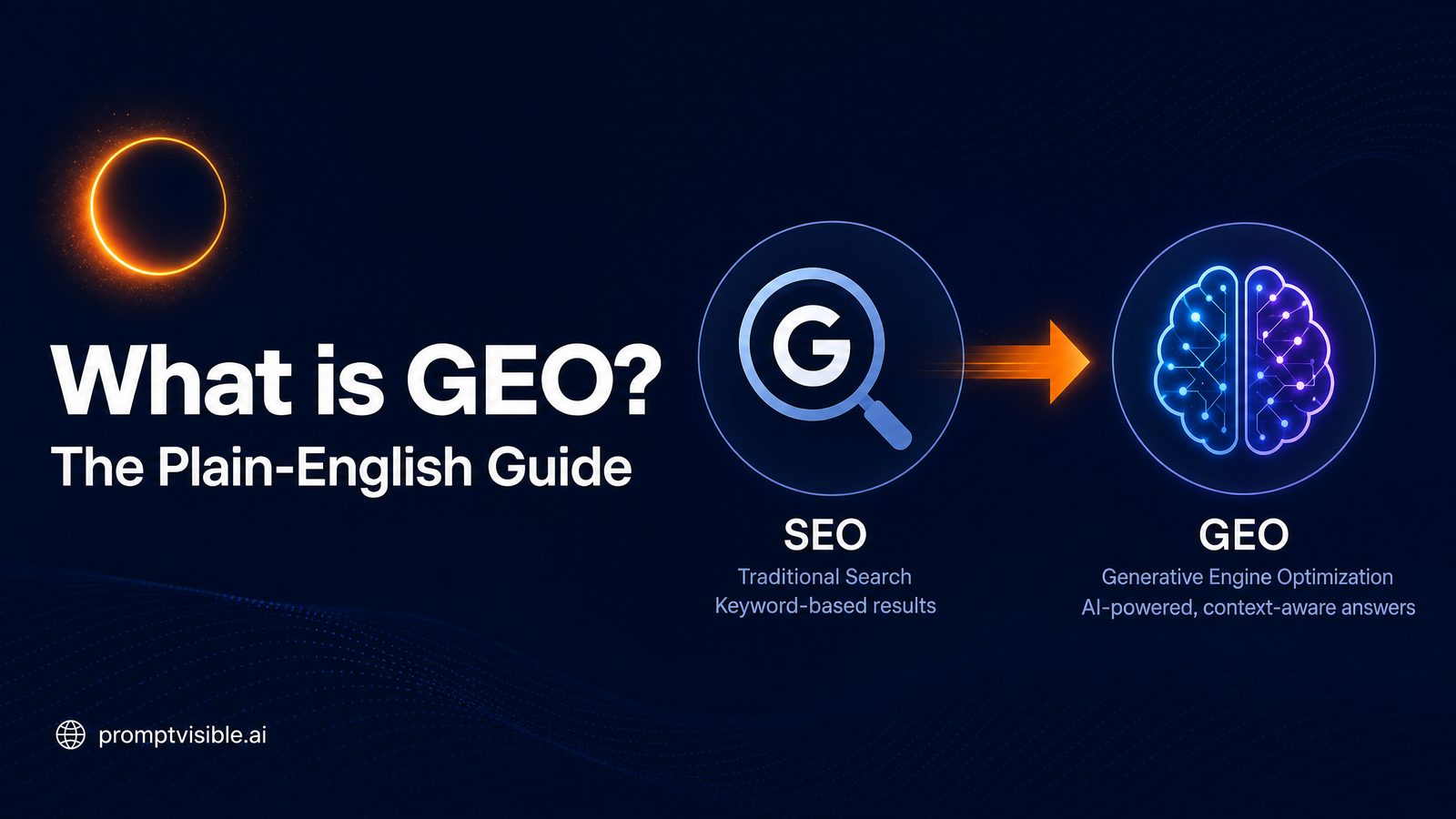
If you have been in business for more than a few years, you know what SEO is. You know the rules: build backlinks, publish content, optimise your pages, and climb the Google rankings. You have probably spent money on it. You may have seen it work.
But in 2026, a second discipline has become just as important, and most business owners have never heard of it.
It is called GEO. Generative Engine Optimisation.
GEO is the process of ensuring your business is cited, recommended, and summarised by AI assistants like ChatGPT, Perplexity, Claude, and Gemini. It is not a rebrand of SEO. It is not a minor update to what you are already doing. It is a fundamentally different discipline that operates by completely different rules.
Here is what you need to know.
The Difference Between a Search Engine and an Answer Engine
To understand why GEO matters, you first need to understand what changed.
A search engine like Google returns a list of links. Its job is to find the most relevant pages on the internet and present them to the user in ranked order. The user then clicks through to the website that looks most useful and reads the content there. Your goal in SEO is to be the link they click.
An answer engine like ChatGPT or Perplexity does something different. It reads multiple sources, synthesises the information, and delivers a complete answer directly to the user. The user does not need to click anywhere. They asked a question and they got an answer.
Your goal in GEO is not to be the link they click. It is to be the source the AI trusts enough to include in its answer.
If you are not cited in that answer, you do not exist to that buyer. They got what they needed and moved on without ever seeing your name.
Why SEO and GEO Require Different Strategies
The reason you cannot simply apply your SEO strategy to GEO is that Google and AI models evaluate authority in completely different ways.
Google's algorithm is built around links. The more websites that link to yours, the more Google trusts you. This is why SEO has historically involved building backlinks, getting press coverage, and earning mentions on authoritative sites.
AI models do not care about your backlinks. They care about three things that have nothing to do with how many sites link to you.
The first is structural clarity. AI models are not reading your website the way a human does. They are scanning it for extractable facts. If your content is built around brand narrative and long paragraphs, the AI cannot confidently summarise what you do. A business it cannot summarise is a business it will not recommend. GEO requires you to restructure your content so that facts are easy to find, easy to extract, and impossible to misinterpret.
The second is off-site consensus. AI models are trained to behave like objective researchers. Before recommending a business, they look for agreement across multiple independent sources. If real people are discussing your brand in Reddit threads, leaving detailed reviews on Trustpilot, and mentioning you in industry forums, the AI builds confidence that you are a legitimate, trusted option. If your only digital presence is your own website and your own marketing materials, the AI has no external validation to draw on.
The third is technical accessibility. AI companies have released their own web crawlers: GPTBot for OpenAI, ClaudeBot for Anthropic, PerplexityBot for Perplexity. Many businesses are unknowingly blocking these crawlers through security configurations that were set up years ago for other purposes. If the AI cannot read your site, it cannot cite you.
The New Technical Standards
GEO has also introduced a set of technical standards that did not exist in the SEO era.
The most important is the llms.txt file. Think of it as the AI equivalent of a robots.txt file, but instead of telling crawlers what they cannot access, it tells AI models exactly what your business does. It is a plain-text file placed in the root directory of your website, written in clear factual language, that gives AI models a direct briefing on your company without requiring them to parse through your entire site. Businesses that have implemented it are giving AI models a significant advantage in understanding and recommending them.
Schema markup, which has existed in SEO for years, takes on new importance in GEO. Structured data that clearly labels your products, services, pricing, and location makes it dramatically easier for AI models to extract and present accurate information about your business.
Why This Matters Right Now
The transition from search engines to AI answer engines is accelerating faster than most businesses realise. Younger buyers in particular are increasingly bypassing Google entirely and going straight to ChatGPT or Perplexity when they need a recommendation.
The businesses that are building their GEO presence today are establishing citation authority that will compound over time. The businesses that are waiting are watching smaller, less established competitors own the AI conversation in their category.
GEO is not a replacement for SEO. Your Google rankings still matter for the users who do click through. But if you are only playing the SEO game, you are invisible to a growing share of your market.
The first step in any GEO strategy is understanding your baseline. You need to know how the major AI engines currently view your business before you can improve it.
Get your free AI visibility snapshot to see your baseline score and one real AI answer about your category.