It is one of the most frustrating things a business owner can experience right now.
You have a better product. You have more experience. You have hundreds of five-star reviews and years of happy customers. You spend real money on marketing to make sure you are the go-to name in your category.
Then one day, out of curiosity, you open ChatGPT and type: "What are the best [your type of business] in [your city]?"
It gives you a list of three names.
Yours is not on it.
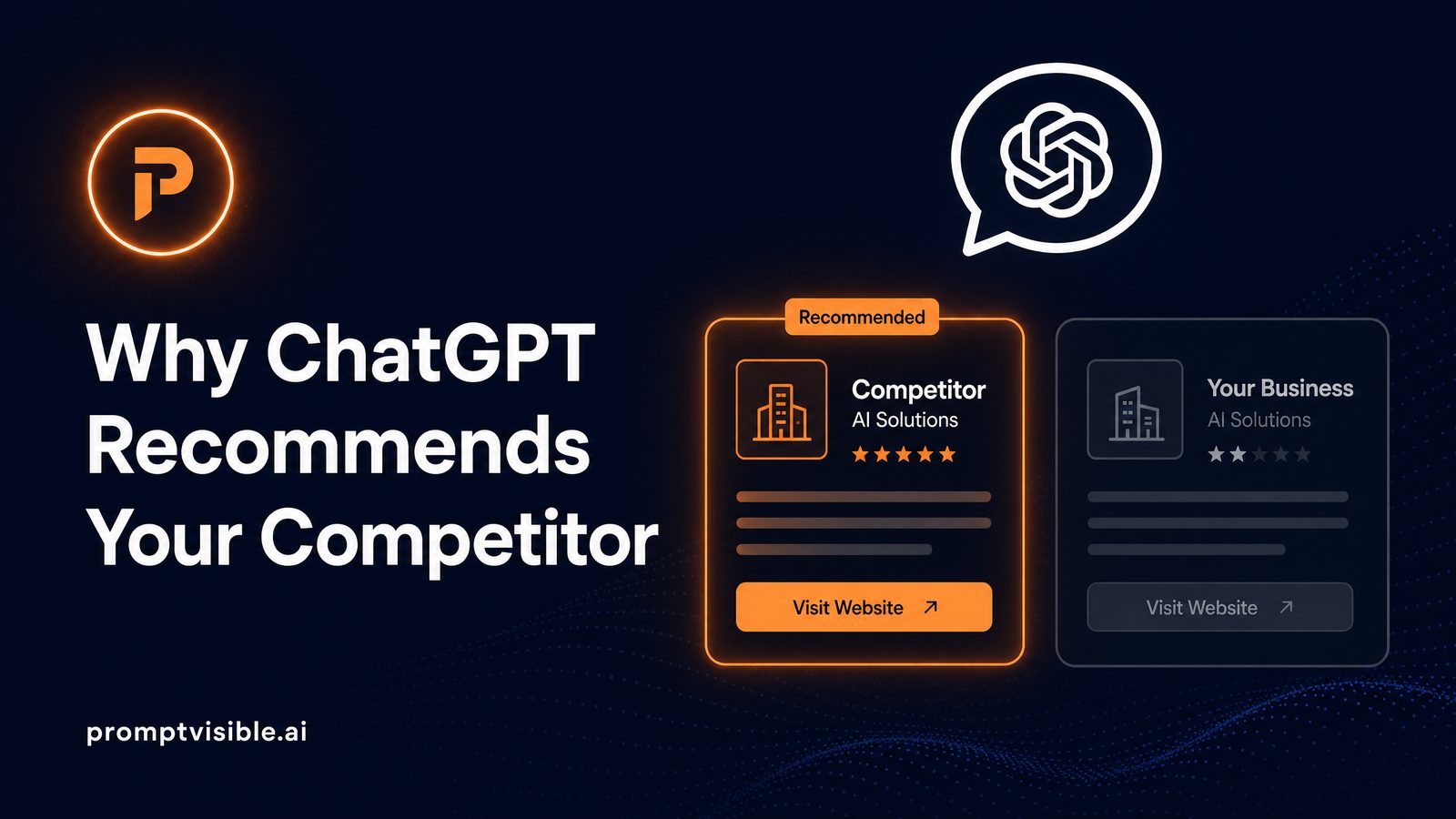
But your smaller competitor is. The one with the newer website, fewer reviews, and a fraction of your history. ChatGPT is actively directing your potential buyers to them instead of you.
This is not random. It is not unfair. It is the result of a specific technical gap, and once you understand it, you can close it.
AI Models Do Not Evaluate Quality. They Evaluate Confidence.
The first thing to understand is that ChatGPT is not making a judgment about which business is better. It does not know who has better customer service or a superior product. It cannot evaluate that.
What it evaluates is confidence. When an AI model generates a recommendation, it is asking itself: which business can I confidently describe to the user based on the information available to me? The business it can describe most clearly, with the most supporting evidence from multiple sources, is the one it recommends.
Your competitor is winning that confidence test. Here is why.
Their Website Is Built for Machines, Not Just Humans
When ChatGPT crawls a website to extract information, it is looking for structure. It wants to find clear, direct answers to simple questions: what does this business do, who do they serve, where are they located, what does it cost?
If your website is built around brand storytelling and long paragraphs of marketing copy, the AI struggles to extract those facts. It cannot confidently summarise what you do. So it moves on.
Your competitor's site is likely structured in a way that makes extraction easy. Clear headings that state the point directly. Short paragraphs where each one makes a single claim. Service pages that list what is included without burying it in narrative. The AI reads their site and immediately understands the business. It reads yours and gets lost in the copy.
This is not a criticism of your website as a human experience. It might be beautifully designed and highly converting for real visitors. But AI models are not human visitors, and they need a different kind of clarity.
They Have a Presence Outside Their Own Website
Google built its authority system around backlinks. The more websites that link to yours, the more Google trusts you.
AI models built their authority system around conversations. The more your business is mentioned in natural, independent discussions across the web, the more an AI model trusts that you are a real, credible option worth recommending.
Your competitor may have a weaker website by traditional SEO standards, but if real people are mentioning them in Reddit threads, discussing them in industry forums, and leaving detailed reviews on Trustpilot or G2, the AI has external validation. It has seen multiple independent sources agree that this business exists and is worth considering. These are the channels that drive AI brand citations.
If your only digital footprint is your own website and your own marketing materials, the AI has no external consensus to draw on. It cannot confidently recommend a business that only talks about itself.
They Are Not Accidentally Blocking the AI
This is a problem that surprises most business owners when they discover it.
Many websites have security configurations or bot protection tools that were set up to prevent scraping and spam. These tools often block entire categories of automated traffic, and AI crawlers fall into that category.
GPTBot, ClaudeBot, and PerplexityBot are the crawlers used by OpenAI, Anthropic, and Perplexity to read and index web content. If your security settings are blocking them, those AI models have never read your website. They cannot cite a business they have never been able to access.
Your competitor may simply have a more permissive configuration that allows these crawlers in. That alone can explain why they appear in AI answers and you do not.
They May Have Implemented the llms.txt Standard
In 2024, a new technical standard emerged specifically for AI visibility. It is called the llms.txt file, and it works as a direct instruction manual for AI models.
Instead of forcing ChatGPT to parse your entire website and try to figure out what you do, an llms.txt file gives it a clean, factual summary in plain language. It states what the business does, who it serves, what the core products or services are, and where to find structured information. It removes all ambiguity.
If your competitor has implemented this and you have not, the AI will default to the business that made itself easiest to understand.
How to Close the Gap
None of these are permanent disadvantages. Every one of them is fixable. The challenge is knowing which ones apply to your specific situation, because fixing the wrong thing first wastes time and money.
The fastest way to find out exactly why your competitor is appearing and you are not is to run a technical AI visibility audit that checks every signal and tells you what to fix in order of impact.
Get your free AI visibility snapshot today and see whether AI names you or your competitors.