There is an assumption spreading through the business world right now, and it is costing companies real money.
The assumption is this: if my business ranks well on Google, it will naturally show up when people ask ChatGPT or Perplexity for recommendations.
It sounds reasonable. It is wrong.
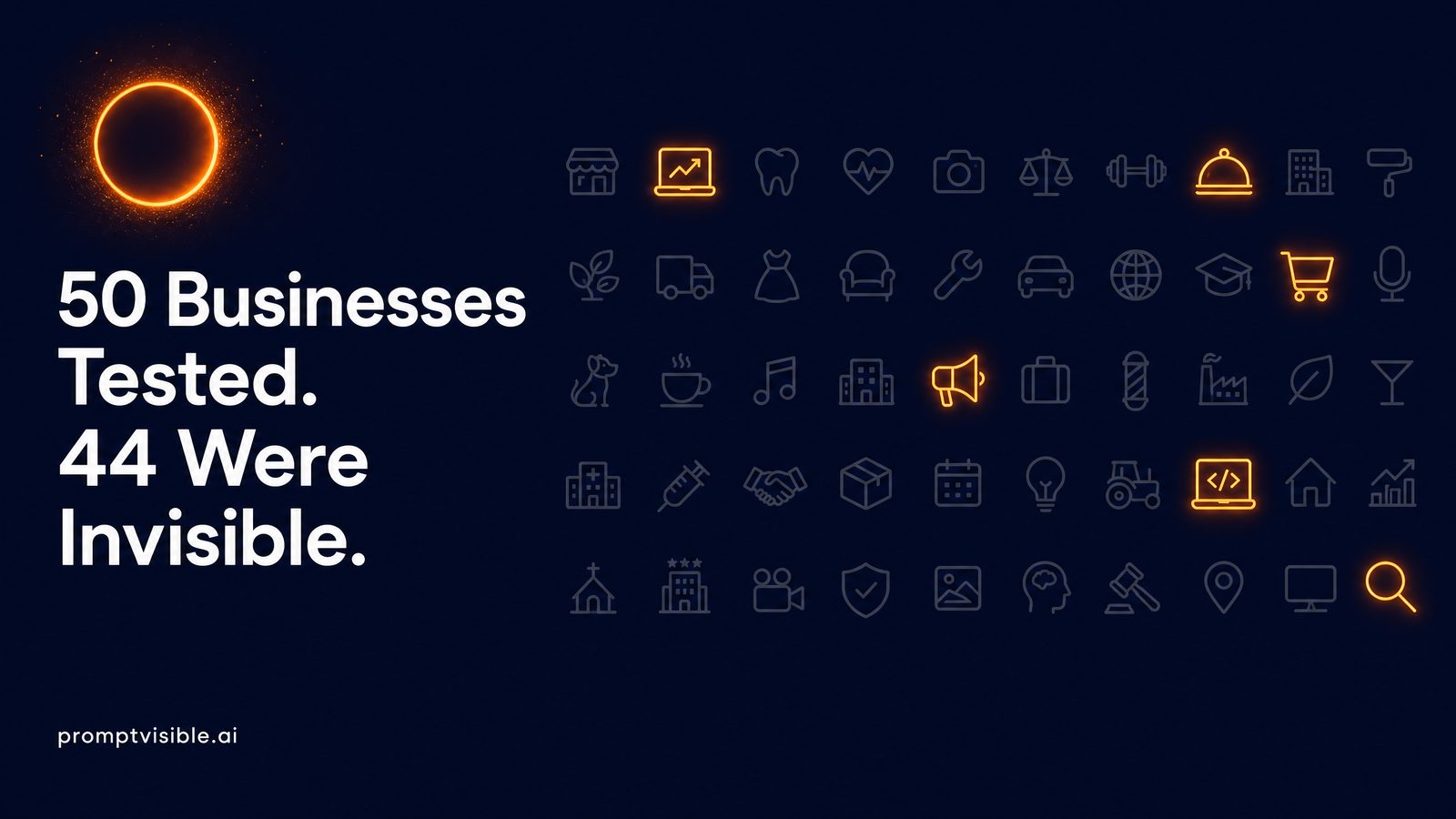
A researcher in the r/smallbusiness community recently ran a straightforward test to find out how many local businesses with strong Google rankings actually appeared when asked about in AI tools. They selected 50 established businesses across different industries and cities. These were not struggling startups. They were companies with Page 1 Google rankings, active advertising budgets, and hundreds of positive reviews.
The researcher opened ChatGPT, Perplexity, and Gemini and asked the kinds of questions real buyers ask every day. Things like "What are the best HVAC companies in this city?" or "Recommend a highly-rated corporate lawyer near me."
Out of 50 businesses, only 6 appeared in the AI results.
The other 44 were completely invisible. The AI engines did not know they existed. When asked directly about some of them by name, the models either had no information or returned vague, uncertain responses. Meanwhile, smaller competitors with weaker websites were being confidently recommended in their place.
Understanding why this happened is the most important thing you can do for your business right now.
Why the 44 Were Invisible
The businesses that failed the AI visibility test were not bad businesses. They were businesses that had been optimised for a game that is no longer the only game being played.
The first problem was content that AI models could not parse. Traditional SEO encouraged long, thorough content that kept users on the page. The invisible businesses had websites full of brand narrative, long introductory paragraphs, and marketing copy that circled around the point without stating it directly. AI models are not reading your website the way a human does. They are scanning it for extractable facts. When the facts are buried in prose, the AI cannot confidently summarise what the business does, and a business it cannot summarise is a business it will not recommend.
The second problem was accidental blocking. Several of the invisible businesses were unknowingly preventing AI crawlers from accessing their sites. Web application firewalls and bot protection tools, often set up years ago to prevent scraping, were blocking GPTBot, ClaudeBot, and PerplexityBot. If the AI cannot read your site, it cannot cite you. It is that simple.
The third problem was isolation. Many of the invisible businesses had strong Google authority built on backlinks, but they had almost no presence in the places AI models look for consensus. They were rarely mentioned in Reddit discussions, industry forums, or detailed third-party reviews. AI models are trained to look for agreement across multiple independent sources before recommending a business. A company that only talks about itself, on its own website, in its own marketing materials, gives the AI nothing external to validate against.
What the 6 Winning Businesses Did Right
The 6 businesses that earned consistent citations across ChatGPT and Perplexity were not always the largest or most established. But they had done three things that the invisible businesses had not.
Their websites were structured for extraction. Clear headings that answered specific questions directly. Service pages that stated what was included without burying it in narrative. FAQ sections with structured schema markup. Pricing information that was easy to find and easy to read. The AI could scan these sites and immediately understand the business. It did not have to work for the information.
Several of the winning businesses had implemented an llms.txt file. This is a plain-text file placed in the root directory of a website that acts as a direct briefing for AI models. It states what the company does, who it serves, and where to find structured information, all in clear, factual language with no marketing spin. It is the fastest technical improvement most businesses can make, and most businesses have not made it yet.
The winning businesses also had a genuine presence outside their own website. They appeared in Reddit threads where people in their category were asking for recommendations. They had recent, detailed reviews on Trustpilot and Google Business Profile. They were included in third-party comparison articles. The AI could look at multiple independent sources and find consistent, agreeing information about these businesses. That consistency is what builds the confidence an AI model needs before it will output a recommendation.
What This Means for Your Business
The shift from search engines to AI answer engines is not a future trend. It is happening now, and the businesses that are invisible in AI today are losing buyers who never even know they exist.
The encouraging part is that every one of these gaps is fixable. The technical barriers are not complex. The content changes are not expensive. The off-site presence can be built systematically. But you cannot fix what you have not diagnosed.
Get your free AI visibility snapshot to see how the major AI engines answer a real question about your category today.