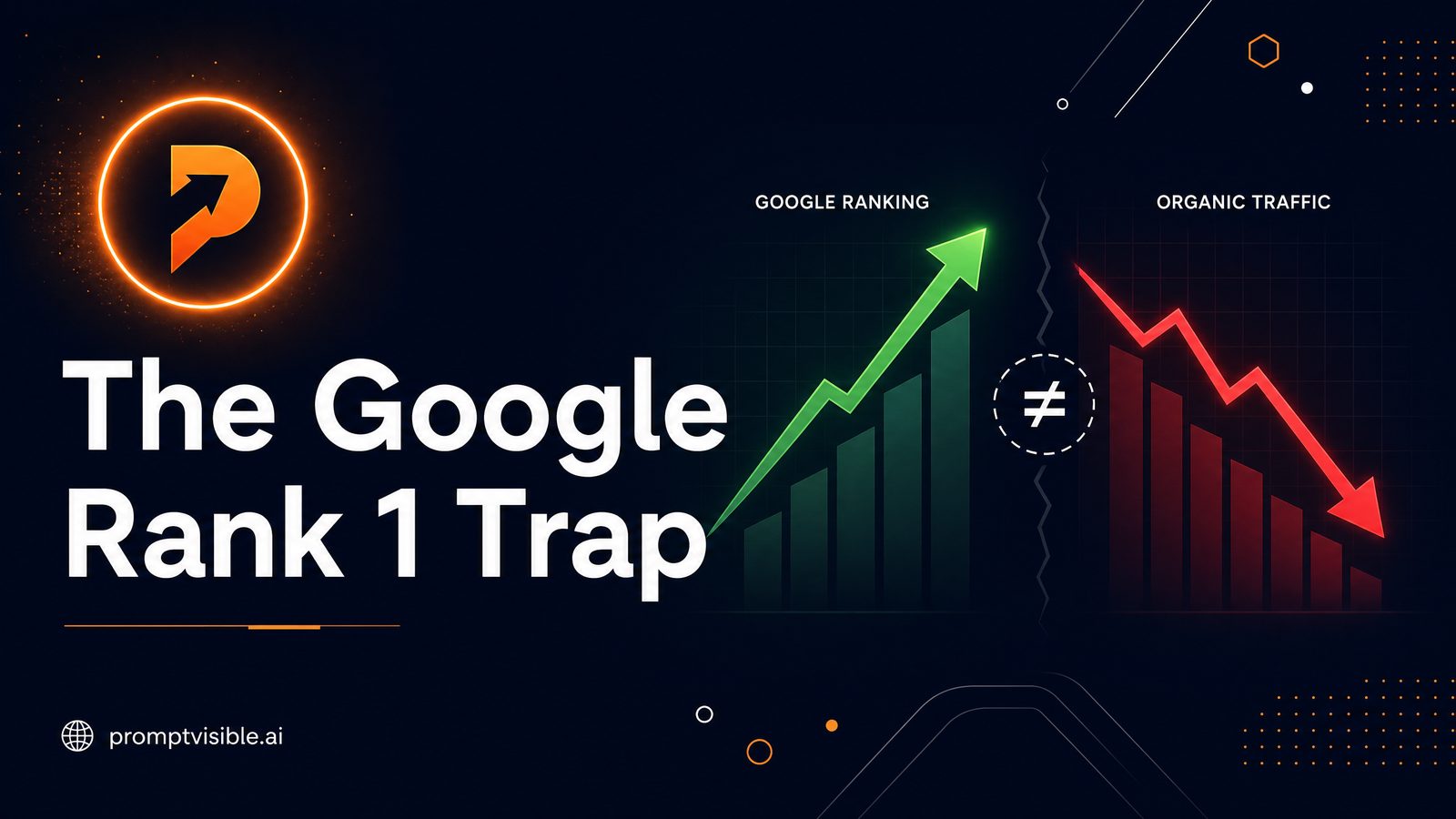
For fifteen years, the goal was simple. Get to Page 1 of Google.
If you hit Rank 1, you won. The traffic flowed, the leads came in, and the revenue followed. Businesses spent tens of thousands of dollars on backlinks, content, and technical SEO to climb that mountain. And for a long time, it worked.
But something changed. And it changed fast.
Businesses across every industry are now hitting Rank 1 for their most important keywords. Their SEO dashboards show perfect health. Their keyword rankings are holding. But their traffic is dying. Their leads are down. And they cannot figure out why.
This is the Google Rank 1 Trap, and understanding it is the most important thing a business owner can do in 2026.
Why Rankings No Longer Equal Traffic
The reason your traffic is falling while your rankings hold is that user behaviour has fundamentally shifted.
When someone searches for a question today, Google places an AI-generated summary at the very top of the results page. The user reads the answer directly on Google. They do not need to scroll down to the blue links. They do not need to click on your website. They got what they came for.
Research from SparkToro found that when an AI summary appears in search results, users click through to a traditional website in fewer than 8% of visits. That means if your business model depends on organic search traffic, you are now competing for 8% of the audience that used to be available to you.
Your Rank 1 position is still there. But the traffic it used to deliver has largely stopped arriving. This is the zero-click reality that is reshaping every marketing dashboard.
The Dangerous Assumption
Here is where the trap gets deeper.
Most business owners who discover this problem assume the solution is straightforward. They think: if I rank number 1 on Google, the AI will naturally pull my content into its summary and cite me. My rankings will protect me.
This assumption is wrong, and it is costing businesses real money.
Google's ranking algorithm and AI recommendation engines evaluate completely different signals. Google cares about domain authority, backlinks, and keyword relevance. It is essentially a popularity contest based on who has the most links pointing at them.
AI engines like ChatGPT, Perplexity, and Claude do not care about your backlinks at all. They care about fact density, structural clarity, and third-party consensus. They are looking for content they can confidently extract, synthesise, and present to a user as a reliable answer.
A business with a 15-year-old domain and 800 backlinks might rank number 1 on Google and be completely invisible to ChatGPT. Meanwhile, a smaller competitor with a newer site but a clean, structured, fact-dense website gets cited in every AI answer for the same category.
The Rank 1 business was built to impress Google's algorithm. The smaller competitor was built in a way that AI models can actually read and understand.
What AI Models Actually Look For
To escape the trap, you need to understand what AI recommendation engines are evaluating when they decide whether to cite your business.
The first thing they look for is structural clarity. AI models are not reading your website the way a human does. They are scanning it for extractable facts. If your homepage is built around brand narrative and long paragraphs of marketing copy, the AI cannot confidently determine what you do, who you serve, or what makes you different. It moves on to a source it can parse more easily.
The second thing they look for is off-site consensus. AI models are trained to behave like objective researchers. They do not trust a single source. They look for agreement across multiple independent platforms. If your business is mentioned consistently on Reddit, in industry forums, on review platforms, and in third-party comparison articles, the AI builds confidence that you are a legitimate, trusted option. If your only presence is your own website, the AI has no external validation to draw on.
The third thing they look for is technical accessibility. Many businesses are accidentally blocking AI crawlers through overly aggressive security settings. If GPTBot, ClaudeBot, or PerplexityBot cannot access your site, they cannot cite you, regardless of how good your content is.
The Path Out
Escaping the Google Rank 1 Trap does not mean abandoning your SEO investment. Your rankings still matter for the users who do click through. But you need to layer a second strategy on top of it.
That strategy is Generative Engine Optimisation, or GEO. It means restructuring your content so that facts are easy to extract, implementing technical standards like the llms.txt file that communicate directly with AI crawlers, and building a genuine off-site presence that gives AI models the consensus signals they need to recommend you.
The first step is understanding where you currently stand. Before you can fix the gap, you need to know exactly what the major AI engines see when they look at your brand today.
Get your free AI visibility snapshot to see your baseline score and one real AI answer about your category.