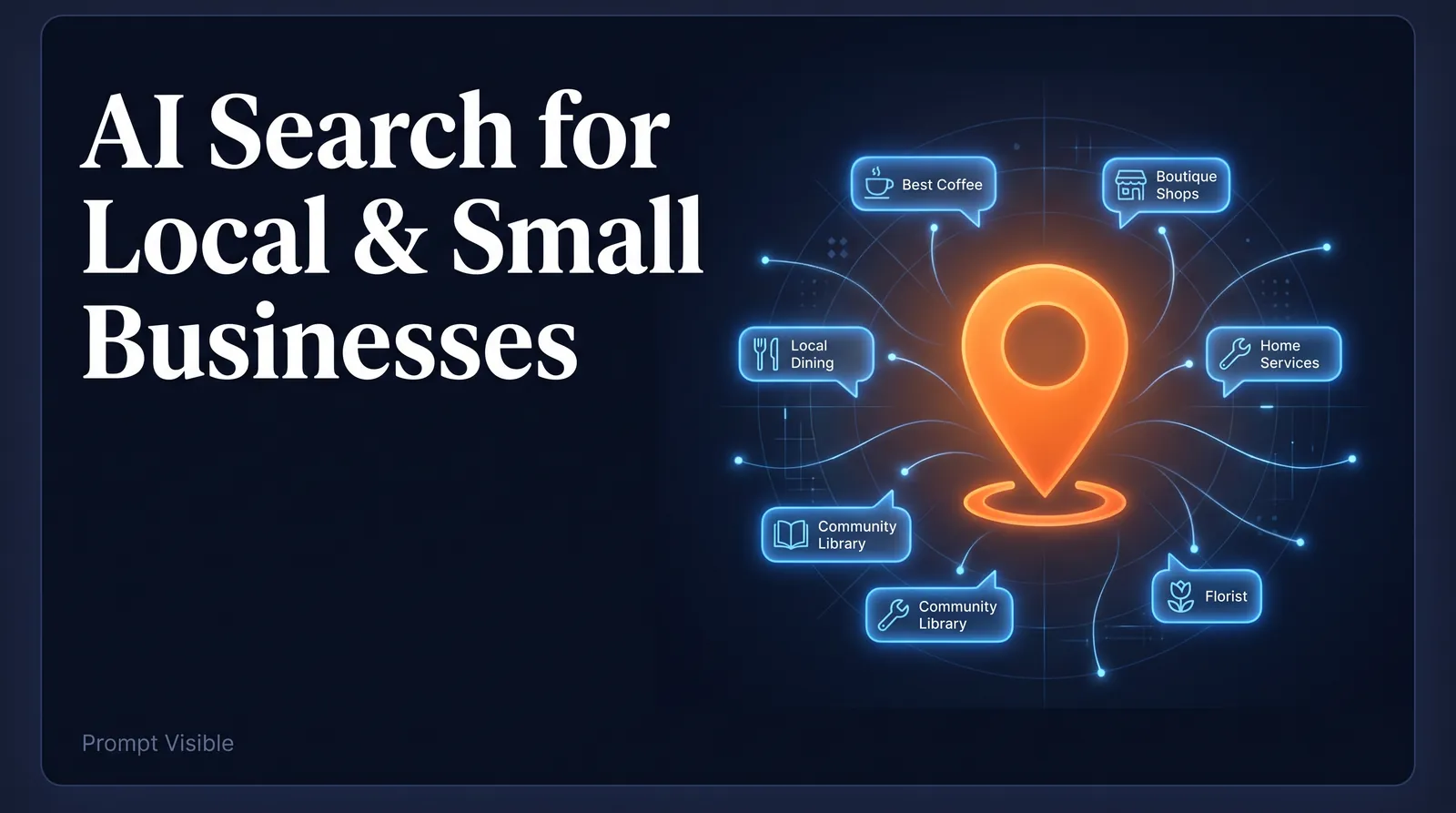
When a customer asks ChatGPT, "What is the best HVAC repair company near me?", how does the AI decide who to recommend? For local and small businesses, the shift to AI search is both a massive opportunity and a significant threat. Unlike traditional Google Local search, which relies heavily on proximity and Google Business Profiles, AI models like ChatGPT, Claude, and Perplexity synthesize data from across the entire web to formulate their answers.
If your local business is not optimized for Generative Engine Optimization (GEO), AI assistants will likely recommend large aggregators (like Yelp or Angi) or your more tech-savvy competitors. Here is how small businesses can win in AI search.
The Local AI Trust Signal: NAP Consistency
AI models hate contradiction. If an LLM finds conflicting information about your business, it will drop you from its recommendations to avoid giving the user a bad answer.
The most critical trust signal for local GEO is NAP consistency: Name, Address, and Phone number.
Your NAP data should match across your website, your Google Business Profile, your Yelp page and every local directory. Pick one way to write your name, address and phone number, and use it everywhere.
The Power of the Review Consensus
When an AI model is asked to recommend the "best" local service, it cannot test the service itself. It relies entirely on review consensus.
Reviews count. When Insites ran 10,000 US local businesses through ChatGPT and Perplexity, the businesses both assistants recommended averaged 133.4 Google reviews, against 10.7 for businesses neither recommended [1]. That is a correlation in one vendor's data, not a rule. And it is not just about the number or the star rating; the text of the reviews matters too.
AI models mine the text of reviews to extract specific features. If you are a plumber, you want reviews that say, "They fixed my water heater on a Sunday night." When a user asks ChatGPT for an "emergency weekend plumber," the AI will match the user's prompt to the specific phrasing in your reviews.
Encourage your customers to leave detailed reviews that mention the specific services you provided.
Speak the AI's Language with Schema Markup
You must explicitly tell the AI what you do and where you do it.
Implementing LocalBusiness Schema markup on your website is non-negotiable. This structured data acts as a direct feed to AI crawlers, clearly defining your:
- Geographic service area
- Operating hours
- Accepted payment methods
- Specific services offered
If you do not use Schema markup, the AI has to guess. And AI models do not like to guess.
Answer the Specifics
Local SEO used to be about stuffing city names into your footer. Local GEO is about answering specific questions.
Create a detailed FAQ page on your website. Answer questions like, "Do you offer free estimates in [City]?" or "What brands of HVAC do you service?" Structure these with clear H2s and concise, one-paragraph answers. AI models love to extract pre-packaged Q&A formats to answer user prompts.
The transition to AI search means local businesses must be more precise with their digital presence than ever before.
Are you invisible to local AI searches? Run the free AI visibility check. We ask ChatGPT, Claude, Perplexity and Gemini one question your customers ask and show you who they named. It doesn't include a fix list. If you want it every month, the $49 plan asks the same 8 customer questions on all 4 assistants and emails you what changed.
References
[1] Insites. "The AI visibility benchmark: how 10,000 local businesses actually perform in ChatGPT and Perplexity." July 2026. Insites sells AI visibility audits. insites.com