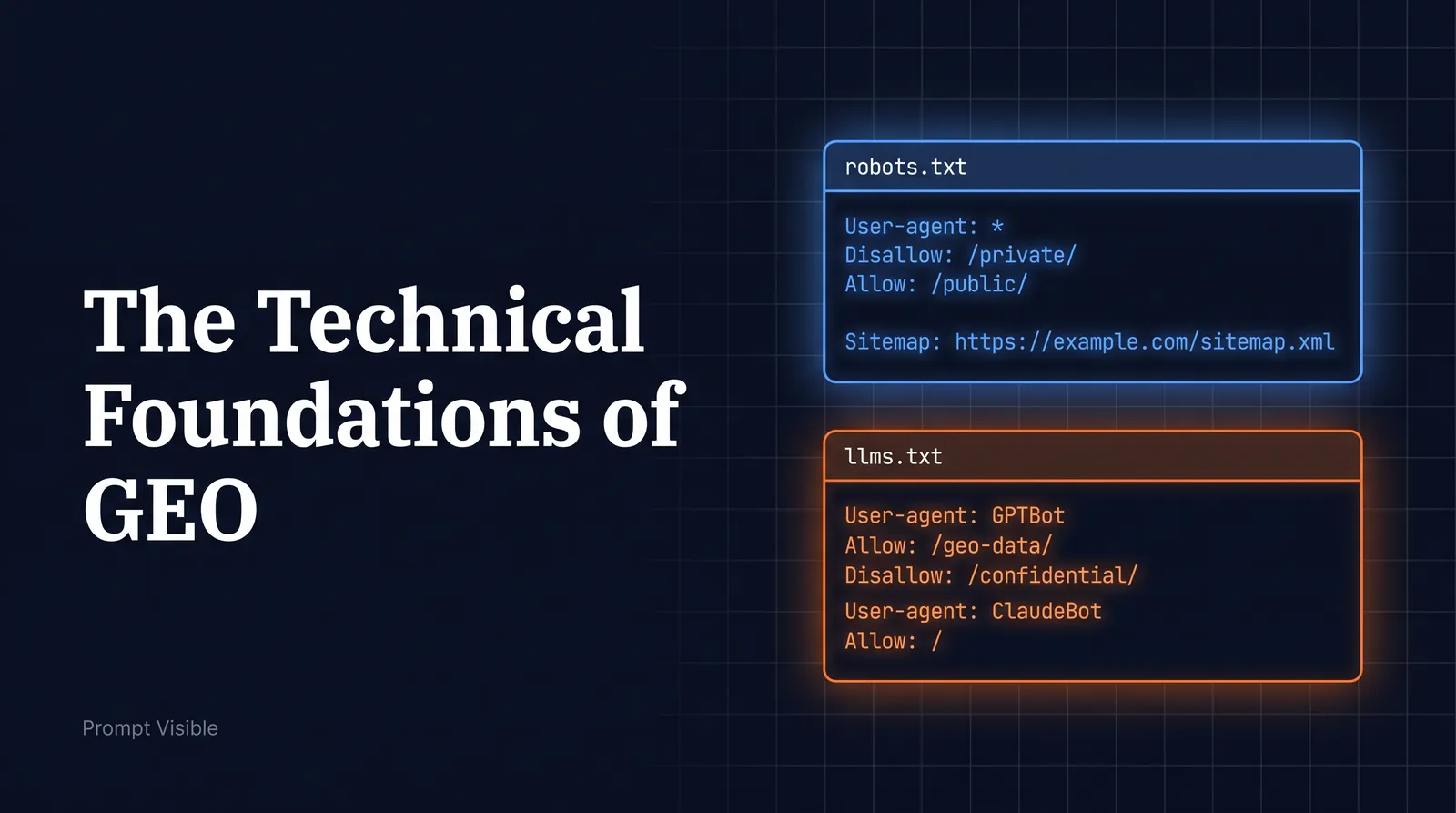
Generative Engine Optimization (GEO) isn't just about writing clearer content. Before an AI assistant like ChatGPT or Perplexity can summarize your value proposition, it must first be able to access, read, and understand your website's data.
Many businesses fail at this foundational step. They invest heavily in content marketing but inadvertently block AI crawlers or fail to structure their data in a way that machines can easily parse. This guide covers the three critical technical pillars of AI search visibility: crawler access, the llms.txt standard, and schema markup.
1. Crawler Accessibility: Are You Blocking the Bots?
The most common reason a brand fails to appear in AI search results is simple: the AI was never allowed to read the website.
AI companies deploy specific web crawlers to index the internet. OpenAI uses GPTBot, Anthropic uses ClaudeBot, and Perplexity uses PerplexityBot. If your website's robots.txt file — or your Web Application Firewall (WAF) like Cloudflare — is configured to block these user agents, your content will not be included in their real-time search results or future training data.
The robots.txt Dilemma
In the early days of generative AI, many publishers rushed to block AI bots to prevent their content from being scraped for training data without compensation [1]. However, as AI transitions from a training mechanism to a primary search and discovery engine, blocking these bots means blocking potential customers.
To ensure visibility in AI search, you must audit your robots.txt file and your server-level security rules to confirm that legitimate AI search crawlers are allowed access to your public-facing, informational content.
2. The Rise of the llms.txt File
Just as robots.txt tells crawlers what not to read, and sitemap.xml tells them where to look, a new standard is emerging to tell LLMs how to understand your site: the llms.txt file.
An llms.txt file is a plain text markdown file hosted at the root of your domain (e.g., yourdomain.com/llms.txt). Its purpose is to provide a concise, machine-readable summary of your website's core information, canonical documentation, and key resources [2].
Why You Need an llms.txt File
When an LLM is asked a question about your business, it often has to piece together information from dozens of scattered pages. An llms.txt file acts as an executive summary for the AI. It allows you to explicitly state:
- What your company does
- Who your target audience is
- Links to your most important, authoritative content (like pricing, core features, or official documentation)
By providing this file, you reduce the cognitive load on the AI and significantly decrease the chances of it hallucinating incorrect information about your brand.
3. Schema Markup: Speaking the AI's Language
Structured data, specifically Schema markup, is the vocabulary that search engines and AI models use to categorize information. While human readers can infer that a block of text is a product review or a pricing tier, an AI relies on Schema markup to definitively categorize that data.
Implementing robust Schema markup is like handing the AI a neatly organized filing cabinet instead of a box of loose papers.
Key Schema Types for AI Visibility
To maximize your chances of being cited accurately in AI responses, prioritize these structured data types [3]:
- Organization Schema: Clearly defines your brand identity, official name, logo, and contact details.
- Product/Service Schema: Details your specific offerings, including pricing, availability, and aggregate ratings. This is crucial for appearing in AI-generated comparisons.
- FAQPage Schema: Marks up frequently asked questions and their direct answers. AI models heavily favor pre-packaged Q&A formats when formulating responses.
The Cost of Technical Invisibility
If your technical foundation is flawed, the quality of your content is irrelevant. AI models will default to citing your competitors who have made their data easily accessible and machine-readable.
Fixing these technical issues is the highest-leverage action you can take to improve your brand's presence in the generative search era.
Not sure where you stand? Check your robots.txt and firewall with the steps above, then see what gets a business recommended. Run the free AI visibility check. We ask ChatGPT, Claude, Perplexity and Gemini one question your customers ask and show you who they named. It doesn't include a fix list.
References
[1] Paul Calvano. "AI Bots and Robots.txt." paulcalvano.com
[2] GitBook. "What is llms.txt? Why it's important and how to create it for your docs." gitbook.com
[3] Conductor. "How to Increase Brand Mentions and Citations in AI Search." conductor.com